
TRADEMARK REGISTRATION CONTAINING GEOGRAPHICAL NAMES – IS IT FEASIBLE IN VIETNAM?
Many enterprises tend to incorporate geographical names (names of communes, districts, provinces, or countries) or their symbolic images to register trademarks. The primary objective is usually to demonstrate goodwill, quality, or simply to enable consumers to associate with the origin of the goods or services bearing the trademark.
“Is it possible to exclusively register a trademark that contains a geographical name or another sign indicating geographical origin?” is a question we frequently receive from our clients.
- LEGAL REGULATIONS
From a legal perspective, the official term stipulated under the current Law on Intellectual Property (IP Law) is “signs indicating geographical origin”. These signs may include geographical names or local symbolic signs (such as emblems, maps, flags, coats of arms, scenic spots, special local structures, etc.).
Furthermore, the Amended IP Law of 2025 has codified a new concept “signs indicating geographical origin of the nation of Vietnam”, which is regulated as a word sign signifying the country name of Vietnam, including “Việt” or “Việt Nam”, and their corresponding English equivalents “Viet”, “Vietnam”, or “Viet Nam”.
Below are the direct regulatory provisions currently in full legal effect.
Article 74, Clause 2 of the current IP Law stipulates:
- A trademark shall be deemed distinctiveness-lacking if it is a sign falling under one of the following scenarios:
đ) Signs indicating geographical origin of goods or services, except where such signs have been intensively used and widely recognized under the guise of a trademark prior to the filing date, or are registered as collective marks or certification marks as prescribed by this Law; for signs indicating geographical origin of the nation of Vietnam of goods or services, compliance with the provisions of point đ1 of this Clause is required;
đ1) Signs indicating geographical origin of the nation of Vietnam of goods or services, except where such signs have been intensively used and widely recognized under the guise of a trademark prior to the filing date, or such signs constitute an element of a distinctive sign registered as a collective mark or certification mark as prescribed by this Law.
Article 77 of Circular No. 10/2026/TT-BKHCN, providing guidelines for the IP Law, stipulates:
- Geographical names and local symbolic signs shall possess the meaning of indicating the geographical origin of goods or services in the following scenarios:
a) Applied to local specialties (special products possessing a reputation due to certain characteristics and produced locally);
b) Applied to local characteristic crops or livestock and products processed from such crops or livestock;
c) Applied to products derived from the exploitation of local natural raw materials (coal, iron, steel, aluminum, cement, stone, salt, wood, etc.);
d) Applied to products belonging to industries highly developed in the locality;
đ) Applied to specific local services (services possessing a reputation associated with certain local characteristics);
e) Other scenarios determined by the nature of the product and the actual usage of the geographical name or local symbolic sign for the product.
Accordingly, in principle, a sign merely indicating geographical origin shall not be accepted for protection as an Ordinary Mark under the law due to its descriptive nature regarding the origin of goods or services. This type of sign is generally protected only as a Collective Mark or a Certification Mark, reserved for specific entities such as legally established collective organizations (Associations, Cooperatives, etc.) or state authorities.
- KEY STRATEGIES TO SUCCESSFULLY REGISTER TRADEMARKS CONTAINING GEOGRAPHICAL NAMES
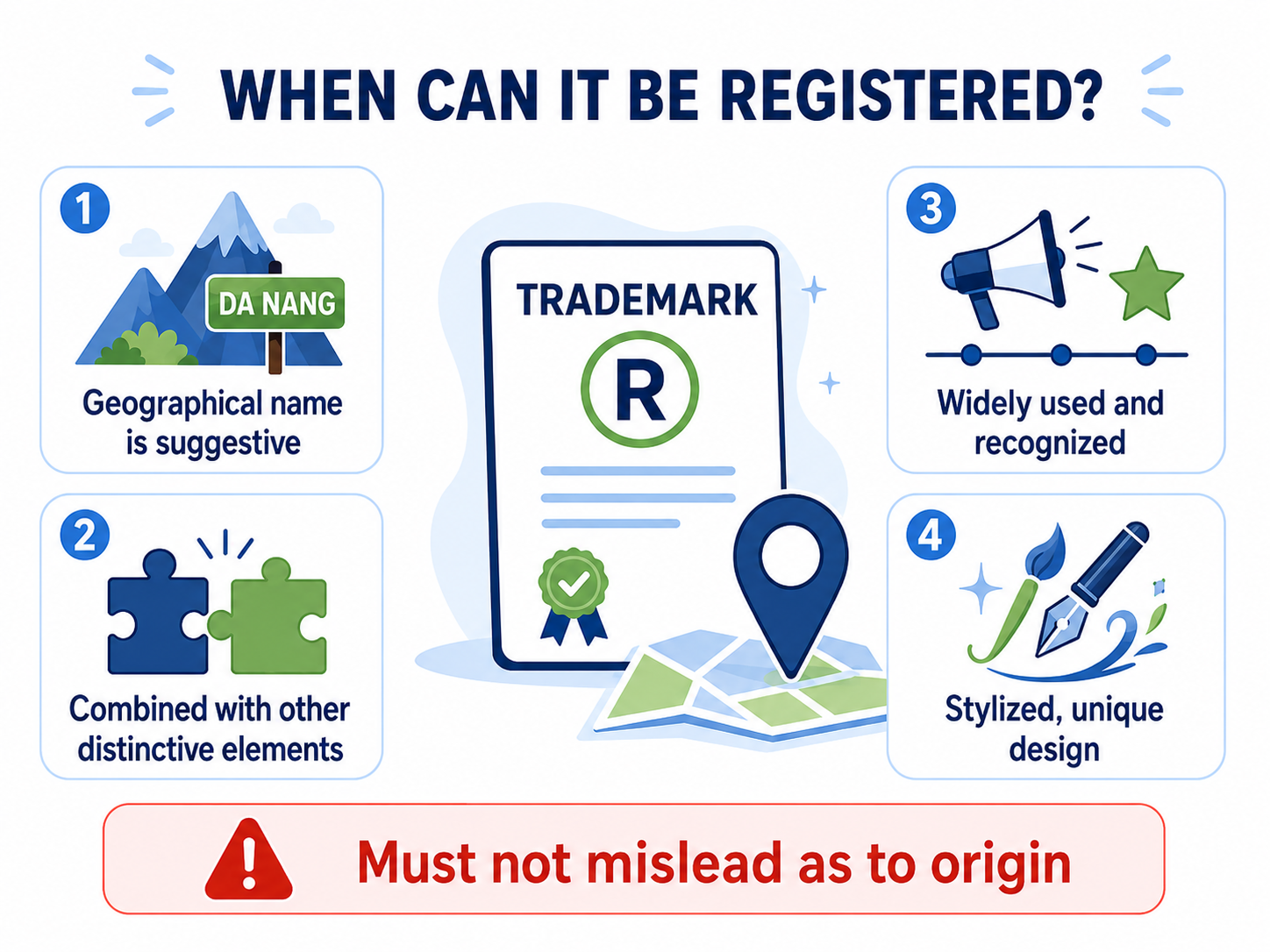
IP legislation still provides clear exceptions for individuals and organizations wishing to register trademarks containing geographical names, provided they satisfy one of the following scenarios:
Scenario 1: The relationship between the geographical name and the goods/services is “arbitrary” or “suggestive
If you use a geographical name where consumers cannot possibly associate that locality with the production venue of the product (meaning the relationship between the product and the geographical name is highly implausible or vague), such a sign is considered distinctive and acceptable for protection as a trademark.
Example: Using the names of high mountain peaks such as “EVEREST” or “MONT BLANC”, or the names of continents like “North Pole” or “South Pole” for products such as pens, eyewear, or clothing. Consumers in this context will perceive them as suggestive brand names rather than assuming that the pens are manufactured on Mt. Everest or that the eyewear is crafted in South Pole.
Scenario 2: The trademark contains a geographical name accompanied by other distinctive components
This is the most common approach chosen by many entities to incorporate geographical names into their applied-for trademark designs. Accordingly, the trademark must be a combination of distinctive word and/or device (figurative) signs and the sign indicating the geographical name, provided that the geographical name conforms to the actual origin of the goods or services (i.e., it does not cause confusion or deceive consumers as to the origin).
In this scenario, the competent authority will grant a certificate of protection for the trademark as a whole, while the geographical name component will be subject to a “disclaimer” – meaning you do not possess exclusive rights to use that geographical name independently.
Example: VIFOOD HANOI; UNILEVER VIETNAM; LOVE COFFEE ĐÀ LẠT.
Scenario 3: The trademark has acquired distinctiveness through use
If a geographical name associated with goods or services has been intensively used and widely recognized under the guise of a trademark prior to the filing date in Vietnam (thereby losing its purely descriptive geographical nature), it may still be protected as an ordinary mark under the statutory exceptions. Typical examples include Bia Hà Nội (Hanoi Beer) and Bia Sài Gòn (Sai Gon Beer).
Scenario 4: The trademark is designed with a highly stylized and unique presentation
This applies to trademarks designed (through stylization, color combinations, or unique graphic illustrations) in an exceptionally original and creative manner sufficient to create a distinct commercial visual impression, thereby qualifying for protection as an ordinary mark.
Similarly, the geographical name must conform to the actual origin of the goods or services (i.e., it does not cause confusion or deceive consumers as to the origin).
- WARNING AGAINST THE “DECEPTION OF CONSUMERS”
An absolute taboo when filing a trademark application containing a geographical name is causing confusion or deceiving consumers regarding the origin and source of the goods or services. If your goods bear no actual connection to that geographical name (not manufactured there, or lacking core processing stages there), the trademark application is highly susceptible to refusal on absolute grounds.
Example: A trademark containing the word “SWISSTIME” for watches, but the products are actually manufactured in Vietnam and possess no connection to Switzerland; or a trademark featuring the Eiffel Tower of France, but the applicant originates from China and the products are manufactured locally there. Such contradictions will immediately be deemed deceptive and consequently refused.
- OUR EXPERT ADVICE
Incorporating a geographical name into a trademark for registration or usage is a double-edged sword. It can instantly elevate the value of products and services, yet it can also result in a total loss of invested costs and time pursuing the trademark application if an enterprise does not thoroughly understand the law.
Therefore, before investing marketing and communication expenses into a brand tied to a specific territory, please contact reputable Intellectual Property Agent organizations to receive:
- Comprehensive trademark search and assessment of distinctiveness.
- Strategic consultation on appropriate design alternatives (combining or stylizing signs) to optimize the probability of protection.
- Proper protection mapping (Ordinary Mark, Collective Mark, or Certification Mark) depending on your entity status and the actual origin of your products or services.
Does your business own a trademark containing a geographical name and feel uncertain about its registrability? Leave your thoughts in the comments section below or contact us directly for detailed advice from our professional IP Attorneys!